
Wayne County Civil Docket Searches
Civil cases in Wayne Superior and State Court run through PeachCourt. It handles e-filing and electronic docket access. An account is required. The case search fields, results, coverage dates, and image prices sit behind the login. So a casual visitor cannot type in a surname. Georgia Courts' E-Access page works as a directory too. It points Wayne searches to a provider rather than hosting a statewide civil case index.
Search smart before you search twice. Bring the case type, the likely court, and the full party name. Add the filing period, and the case number if you have it. When PeachCourt returns nothing, call Frances B. Yeargan's Wayne County Clerk of Court office at 912-427-5930. Counter service is available at 174 N Brunswick Street in Jesup. Confirm mail instructions before sending a written request. Probate and Magistrate matters go to their own clerks.
- Decide whether Superior, State, Magistrate, or Probate Court holds the civil matter.
- Register with PeachCourt for a Wayne Superior or State search.
- Use only the fields and result labels shown in the authorized account.
- Review the chronological docket before selecting a document image.
- Request a plain or certified copy from the correct clerk when needed.
Wayne Civil Docket E-Filing Line
The Wayne civil e-filing instructions draw a hard line at January 1, 2019. Any new Superior or State civil case started on or after that date must be e-filed. This applies to attorneys and self-represented litigants alike. Those exclusions cover pauper's-affidavit matters, sealed cases or motions to seal, sealed depositions, and ex parte or in-camera material, subject to stated exclusions. The official page also notes a computer at the clerk's office for e-filing. There is no e-filing charge at that terminal.
What the official page documents is mandatory e-filing and the terminal option. It promises no free public docket terminal, no free document images, and no online access to restricted material.
Civil Dockets: What They Show
Think of a Wayne County civil docket as an index, not the whole pleading file. A docket line can show the filing date of a complaint or petition. It can also show the return of service, later answers and motions, a hearing setting, and any order or judgment the judge entered. It marks the activity. The signed pleading, exhibit, return, or order may live separately. It may be an image or a paper record.
| Case number | The court’s identifier; no public Wayne format was verified. |
|---|---|
| Caption and parties | Plaintiff or petitioner, defendant or respondent, and other roles. |
| Service | Issuance and return of summons or other notice when recorded. |
| Filings | Complaint, answer, motion, response, notice, or discovery entry. |
| Setting | A hearing, status event, trial, or other scheduled proceeding. |
| Disposition | Judgment, dismissal, settlement-related order, or another outcome. |
Wayne civil docket results sit behind the account gate, so no sample fields can be listed here. Treat a field as confirmed only once you see it in an actual result.
Wayne Civil Docket Assignment System
General civil cases in Wayne Superior Court get spread equally among four judges. That rule comes from the local civil assignment page. The method is administrative. It spreads filings evenly, nothing more. No party gets to pick a judge, and each judge does not keep a separate public database.
You may spot the judge assignment in the case header. Later docket entries may show it too once the case is opened. Reassignment, recusal, or a special order can change the judge on a matter, so the latest official entry always controls. The clerk's Superior Court judge directory lists public office contacts. Confirm which judge and courtroom apply to a specific setting. Use the docket or the clerk.
Key point: Four-judge assignment explains case routing, but the Wayne clerk remains the shared record custodian for Superior Court civil files.
What Cases Fill the Civil Docket
Wayne Superior Court serves as the main forum for general civil actions. It also handles domestic relations, equity, title to land, divorce, and matters reserved to that court. State Court takes civil actions that are not exclusive to Superior Court. Under Georgia's court structure, Magistrate Court handles smaller claims. It hears civil claims up to $15,000. Probate Court separately holds estates, wills, and guardianships. A city municipal court is not the normal venue. Contract, property, and domestic cases do not belong there.
| Wayne venue | Civil docket focus | Record route |
|---|---|---|
| Superior Court | Major civil, domestic, equity, land title | PeachCourt and Wayne clerk |
| State Court | Civil matters not reserved to Superior | PeachCourt and Wayne clerk |
| Magistrate Court | Claims up to $15,000 and other assigned work | Magistrate office |
| Probate Court | Estate, will, and guardianship records | Separate Probate office |
A failed search usually means the wrong office. Recheck the initiating paper before retrying the same portal.
Wayne Civil Docket Filing Costs
Filing fees and search fees are different things. The Wayne civil fee page lists $213 for a general Superior civil action. It also lists $216 for a general State civil action, and $207 for an appeal from a lower court. Service, publication, and special-action costs may be added on top. Personal checks are not accepted for filing fees. The page gives separate-payee instructions for some service costs. The published fee table is handy when reading a new filing.
The official fee table backs those amounts. Still, confirm the total and payee before you pay. These sums say nothing about what PeachCourt charges for an image or what a copy request costs.
Hearings on the Civil Docket
A setting on a Wayne civil docket is a scheduled event. It is not a judgment, and it is not always a trial. Expect entries for motion hearings, status conferences, pretrial events, bench proceedings, or trial settings. Scheduling orders sometimes add filing or discovery deadlines instead. The clerk offers no working public calendar view for these events. Verify each setting against the latest docket entry. Then call the clerk.
Write down the date, time, court, judge, courtroom, and event type. Check for any reset entry too. A continuance only moves the event; it never dismisses the case. A notice of hearing is also just a request. The later order decides the motion. The separate Wayne County court schedule explains the local calendar fallback in more depth.
- Motion
- A request asking the court to act.
- Order
- The court’s written ruling or direction.
- Continuance
- A postponement to another date.
- Default judgment
- A judgment entered under applicable procedure after a party fails to respond or defend.
Wayne Civil Docket Form Library
Need to file rather than look up? The clerk maintains a general civil and domestic forms page organized by category. Divorce with children and divorce without children appear there. Modification of custody or child support appears there too. Remember what the page is. It is a filing-form library, not a case lookup. It will not reveal whether any named person has filed.
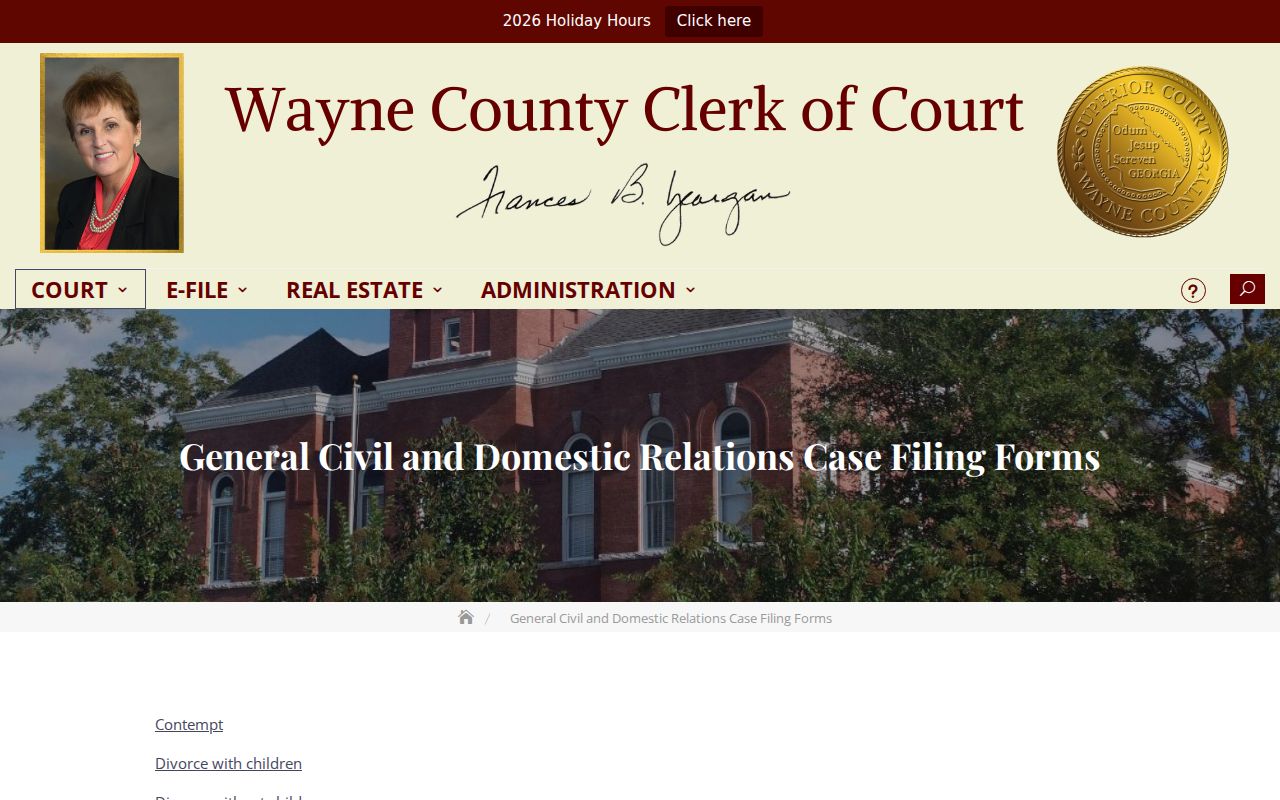
Forms can still help. They let you identify the likely filing type before you contact anyone. Accepted, entered, set for hearing, or ruled upon? The official docket remains the source. Forms do not settle jurisdiction either. A document prepared for Superior Court tells you nothing. It cannot say whether a Magistrate or Probate file belongs in PeachCourt.
Wayne Civil Docket Copy Options
Sometimes a docket line is not enough. When that happens, request the underlying document from the clerk. The Wayne miscellaneous-cost page lists the local rates. An uncertified copy without assistance runs $0.50 per page. With assistance, it is $1 per page. A certified or exemplified copy maps to $2.50 for the first page plus $0.50 for each additional page, while electronic and fax charges follow another schedule. The official copy-cost capture displays these distinctions.
Before ordering, confirm how the clerk applies that cost table. Ask especially about electronic delivery or certification. A portal printout is not automatically a certified copy.
When an image is missing, note the details. Give the court, case number, entry date, document title, and the copy type you want. Call the clerk first. The clerk publishes no Wayne-specific downloadable mail request or turnaround time.
Older Wayne civil files may need more than an image search. Give the clerk an approximate filing year and the caption as filed. Name the court and the specific order or pleading sought. Ask whether the file is scanned, stored on site, archived, or subject to a retention rule. A docket entry can remain available regardless. A large exhibit or paper volume may follow a different storage process. For a transcript, ask for the court reporter's route. The docket itself is not the spoken record.
Who Can See Civil Dockets
Georgia court records start from a public-access baseline. Access may still be limited by law or by a sealing order. Uniform Superior Court Rule 21 governs public access. It also sets the procedure for restricting a Superior Court record. Rule 36.16 addresses e-filing and its limits. Wayne's own e-filing notice goes further. It excludes sealed cases, motions to seal, sealed depositions, and ex parte or in-camera information from ordinary mandatory e-filing.
Public does not mean wholly online. Uniform Superior Court Rules 21, 36.16, and 39 cover access, electronic filing, and docketing. Georgia Open Records guidance explains requests to a custodian and exemption notices.
A public docket entry does not prove the allegations in a complaint. It reports procedural activity and nothing more. If an image is missing, there is a reason. It may be a fee gate, an unscanned file, archival storage, protection, or another court's custody. Ask for the legal or practical reason instead of guessing.